Zhejiang Yifang White Cast Acrylic Board Thickness Specification and Selection Guide
$1.15 available: In StockQuick Overview: Zhejiang Yifang New Materials, with 20 years of production and processing, international standards, and a daily output of 70 tons.
Zhejiang Yifang White Cast Acrylic Board Thickness Specification and Selection Guide
The application of white cast acrylic panels in advertising signs, LED backlighting, sanitary ware, furniture decoration, and other fields is becoming increasingly widespread. The correct specification selection directly affects the product's effectiveness, lifespan, and cost-effectiveness.
The thickness specifications of the white casting board range from 1mm to over 50mm, with sizes ranging from standard 1220 × 2440mm to fully customized according to the drawings. The colors also have various subdivisions such as pure white, matte white, pearl white, etc. Finding the optimal balance between thickness, performance, and cost is a practical challenge faced by many buyers. Zhejiang Yifang New Materials, as the source factory, provides the most suitable white casting board solutions for various application scenarios with complete specifications and direct supply prices. This article will systematically interpret the complete selection system for white cast plates from four dimensions: thickness specifications, application selection, procurement guidelines, and common questions.
The specification system for white cast acrylic panels is very mature, covering complete options for thickness, size, and color effects.
Overview of Thickness Specifications
Thickness level, thickness range, characteristic description, thickness tolerance
Ultra thin 1mm-2mm lightweight and flexible, suitable for fine processing ± 0.2mm
Thin 2.5mm-5mm market mainstay, balanced strength and cost, with the highest cost-effectiveness of ± 0.2mm
Medium thickness 6mm-10mm structure stable, good bending resistance ± 0.3mm
Thick 12mm-20mm, strong load-bearing capacity, suitable for large structural components ± 0.3mm
Extra thick 20mm-50mm+engineering grade thick plate, requiring professional customization by the manufacturer with a tolerance of ± 0.5mm
The conventional thickness of white cast boards can extend from 2mm to 50mm or even thicker, with 3mm and 5mm being the most in demand specifications in the white board market.
Standard size specifications
The standard size of white casting board is 1220 × 2440mm (4 feet × 8 feet), which is the most commonly used, with a single sheet area of about 3 square meters, suitable for most application scenarios such as lightbox panels, signage, display stands, etc. In addition, there are various specifications available, such as 1220 × 1830mm (4 feet × 6 feet), 1500 × 3000mm, 2050 × 3050mm, etc. The casting board size of Jinbao brand can reach 1000 × 2000mm, 1200 × 1800mm, 1220 × 2440mm, etc. In terms of customized dimensions, the white cast board supports cutting to any size as needed, and the maximum width can be customized to 1280mm or more to meet various special project requirements.
Color effect segmentation
There is not only one type of white. White cast boards can be subdivided into pure white glossy boards (with high gloss and glossiness, used for high-end displays and lightbox panels), matte whiteboards (with frosted texture, non reflective, soft visual effect, suitable for wall panels and furniture finishes), pearl whiteboards (with added pearl effect, luxurious texture, used for high-end decoration and gift design), and glossy whiteboards (with mirror effect on the surface, used for bathroom cabinets and high-end bathrooms).
The thickness selection of white casting board is a decision that requires comprehensive evaluation based on different usage scenarios. The following are thickness recommendations subdivided by application scenarios:
Recommended thickness explanation for application scenarios
LED backlight layer 1-2mm lightweight and high transparency, suitable for fine carving, safe within a span of 1 meter
Small size display board (<0.5 ㎡) 2-3mm load-bearing capacity 1-5kg, cost controllable
Advertising signs/lightbox panels with a main specification of 3-5mm, balancing strength and transparency
Medium sized display rack (0.5-1 ㎡) 4-6mm with a load-bearing capacity of 5-15kg, suitable for display in shopping malls
Furniture partition/wall panel 5-8mm, with a span of 1 meter, can safely support a weight of 15-30kg
Bathroom cabinet/cabinet door 6-10mm needs to be waterproof and moisture-proof, thick board is more stable
Sanitary ware/bathtub countertop 8-12mm with a load-bearing capacity of 30kg+, requiring high strength and water resistance
Large display structures (>2 ㎡) with a load-bearing capacity of 10-15mm and a capacity of 50kg+, it is recommended to add reinforcement bars
Industrial protective cover/equipment cover 10-20mm high impact resistance, selected as needed
In actual procurement, it is necessary to prioritize meeting the minimum thickness threshold, allocate the budget reasonably, and request samples from suppliers for actual load-bearing testing, while reserving a safety margin (recommended+20%).
When choosing white cast acrylic panels, the following five aspects are the key to determining the success or failure of the procurement.
1. Confirm the grade of raw materials
The grade of raw materials is the most crucial factor determining the quality and price of white cast boards. The board is produced using imported new MMA raw materials, with pure and stable white color, a light transmittance of ≥ 92%, excellent UV resistance, and no yellowing for 5-10 years outdoors; The boards containing recycled materials not only turn white, gray, and yellow, but also show obvious yellowing after six months outdoors. They may also emit a pungent odor during cutting. It is recommended to prioritize products that are clearly labeled as "100% brand new" and may require suppliers to provide raw material testing reports.
2. Clearly define the thickness and tolerance
The thickness is not necessarily what is "nominal". Some unscrupulous merchants use the tolerance space to "shrink", claiming that the actual thickness of the 5mm board may be less than 4.5mm, resulting in the board becoming soft and easily deformed. Suggest using calipers for multi-point measurement verification during procurement. The thickness tolerance of pure new acrylic sheet is stable at 0.1-0.2mm, and the maximum difference in thickness of recycled sheet can reach 0.5mm.
3. Distinguish between cast plates and extruded plates
Although both cast and extruded boards are white sheets, there are significant differences in their performance. The white casting board has uniform coloring throughout, high hardness, scratch resistance, and no crystal points on the surface, suitable for laser engraving and CNC precision machining; The surface of the white extruded board may have fine patterns, poor weather resistance, and is prone to yellowing outdoors, but it is cheaper and suitable for large-scale standardized hot bending and vacuum forming applications. For indoor non load bearing large-scale applications, extruded boards can be considered to save costs, while cast boards must be selected for outdoor or high-end display scenarios.
4. Request sample testing
Before bulk purchasing, it is recommended to request samples from suppliers for testing. The testing content includes but is not limited to: cutting test - observing whether the edges are smooth and whether there is a pungent odor; Hot bending test - heat to 160 ℃ to see if it softens evenly and if there are any bubbles; Load bearing test - simulating the load-bearing capacity under actual usage environment; Appearance inspection - observe color uniformity and surface flatness under illumination.
5. Choose the source factory
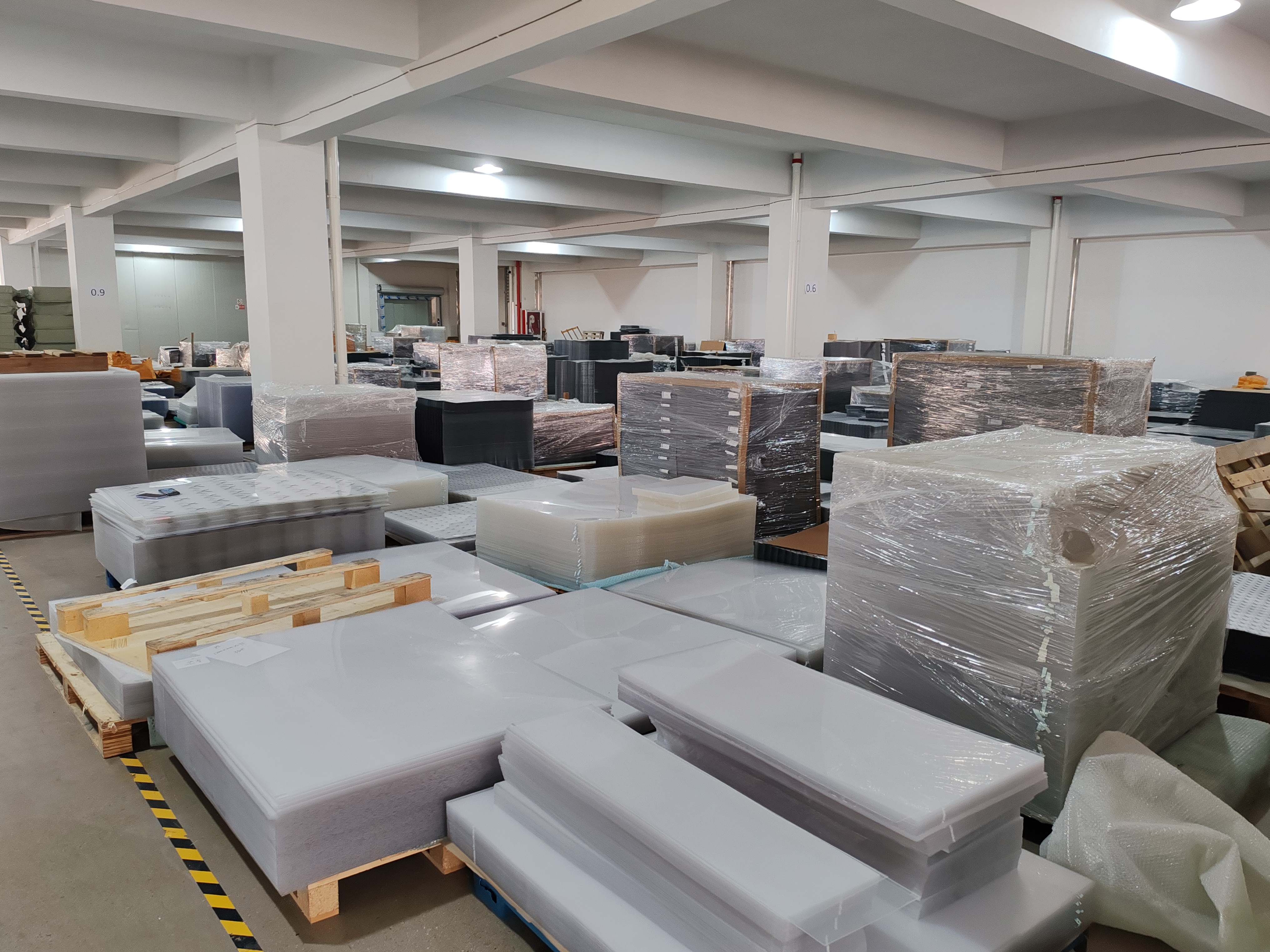
Direct supply from the source factory ensures more controllable quality, transparent pricing, and guaranteed delivery time than layer by layer distribution. Zhejiang Yifang, as the source factory, has independent and controllable control over the entire chain from raw material procurement to finished product delivery, with prices more than 30% lower than the market for the same quality. Support small-scale trial orders to confirm quality before mass production, effectively reducing procurement risks.
Q1: What is the main difference between white cast board and white extruded board?
The casting board is slowly polymerized by injecting liquid MMA monomer and pigment directly into the mold. The color is completely consistent from inside to outside, with high molecular weight, good rigidity, scratch resistance, no crystal points on the surface, and an outdoor weather resistance life of 5-10 years. It is suitable for precision machining. Extrusion board is formed by melting and extruding granular raw materials, with a relatively uniform color distribution but may have subtle patterns on the surface. It has poor weather resistance and low cost, making it suitable for large-scale standardized applications. For outdoor use or scenarios that require high surface smoothness, it is recommended to prioritize the use of cast plates.
Q2: What should be paid attention to when laser cutting white casting boards?
The sensitivity of white cast plates to laser power is similar to that of transparent plates. A recommended power of 60-80W and a speed of 10-20mm/s for a 3mm thickness can achieve smooth fire polished edges. It is recommended to keep the protective film on the surface of the board during cutting until the processing is completed to prevent smoke from contaminating the surface of the board. Before cutting, use waste materials of the same thickness for trial cutting to find the optimal parameters before formal cutting, which can effectively avoid problems such as edge burning or incomplete cutting.
Q3: What is the typical delivery time for white cast boards?
As the source factory, Zhejiang Yifang has regular stock of standard specification white cast boards, and regular orders can be shipped within 48 hours. Bulk customized orders rely on our own R&D team and automated equipment for flexible production scheduling, with efficient delivery typically taking 3-10 days. Urgent orders can be prioritized through communication with customer service for scheduling. The scale advantage of the company's annual output of 22500 tons and daily production capacity of 70000KG ensures timely delivery with sufficient production capacity.
Q4: Can white cast boards be used outdoors?
Sure, but a brand new white cast board with added UV absorbers must be selected. After adding anti UV components to the new material casting board, it will not yellow or fade for 5-10 years when used outdoors; White boards containing recycled materials or without UV resistance will show obvious yellowing and fading within six months outdoors, making them completely unsuitable for outdoor use. When purchasing, it is necessary to confirm whether there is a clear explanation of UV resistance performance, and a QUV accelerated aging test report can be requested for verification.
Q5: How much is the price of white board more expensive than transparent board?
White boards increase material costs and production complexity due to the addition of colorants, and are generally 10% -20% more expensive than transparent boards. Taking the conventional all-around 1.7mm-3.0mm transparent board as an example, the price ranges from 56 yuan to 96 yuan per sheet, with the white board increasing by 10% -20% on this basis. But the specific premium varies depending on the color formula, with a lower premium for pure white boards and a higher premium for special surface effects such as pearl and matte. Large quantities can be negotiated, it is recommended to request a specific quotation for white boards before bulk procurement.
Q6: How to ensure the quality of Zhejiang Yifang white casting board products?
Zhejiang Yifang has passed ISO9001 quality management system certification and ISO14001 environmental management system certification. The products strictly follow the full process quality control management from raw material testing, production process monitoring to finished product delivery. The company uses imported high-quality PMMA raw materials with a light transmittance of ≥ 92%. After adding ultraviolet absorbers, it will not yellow or crack outdoors for 10 years. The white board is pure and full, with a full body coloring, and the cutting edge is smooth and transparent without any blemishes. The product meets export environmental standards and provides unconditional after-sales guarantee for returns and exchanges in case of quality issues.
| product type | pet、ps、acrylic、acrylic mirror、pvc sheet,acrylic sheet |
| thickness | 0.35-300mm |
| Styles | 1220*2440,1220*1830,500*900,50*60,960*1950,700*900/Customization of various specifications and sizes |
| delivery time | 5-8day |
| manufacture | Yifang |
related products